Welcome to Yesler Swamp! Please feel free to use this walking tour guide to make your experience as fulfilling as possible!
 Here is a map to go along with the guide. Each number on the map corresponds to a specific station. The rightmost trail (when walking - it's the left side on the map) contains stations 1, 2, 6, 7, 8, 9, and 10. The leftmost trail contains stations 1, 2, 3, 4, and 5.

Station #1 - Plants
As you enter the swamp you are welcomed by some large nootka rose bushes and some baldhip rose bushes. The best way to tell the difference of these two roses apart is to feel their thorns. The nootka rose has very big and strong thorns that could easily cut you, where as the baldhip rose has thorns that are pretty wimpy and can be bent easily. These are just two plant species of the many you will see within the swamp. The reason I like to begin with plants is because they are something that you can actively be observing all throughout your visit to the swamp. The diversity and uniqueness of plants found in the swamp is intriguing. There are western red cedars, Douglas firs, and many cottonwoods. Western red cedars have leafs that are flat and scaly, Douglas fir leafs are conical and when you grab the needles they aren’t very sharp, and the cottonwoods are the tall trees with the kinds of leafs that one would draw if they were asked to draw a leaf. Some other plants in the swamp include ferns, horsetails, and my favorite – skunk cabbage. There are two common ferns in the swamp, one being sword fern and the other being lady fern. Sword fern have leaflets that come straight to a point, whereas lady ferns leaflets break into even more leaflets. These ferns are very abundant and really thrive in the swamp. There are also quite a few horsetails which look a little like asparagus growing out of the ground. I only know of one skunk cabbage in the swamp, and in early May its yellow leaf is very bright and vibrant which is why it’s my favorite. It also has an interesting smell that always lets me know I’m in a wet marshy kind of place.

Nootka Rose in bloom
Station #2 - Fungi/Lichen
As soon as you enter
the swamp, you are bombarded by mushrooms to your right! Around mid-May is when
there is the greatest amount, but you should be able to find something all
throughout spring. An interesting thing about mushrooms
is their relationship with trees and plants around them. Mycorrhizal fungi are
mushrooms whose hyphae (think roots) connect to tree roots. This gives the
mushroom nutrients, and it gives the tree more water because it’s like the
roots are extended.
Another type of fungi is lichen. These can be found on
many of the trees throughout the swamp. These organisms are very interesting
because of their remarkable survivability. They can be found from an extremely
wide range of temperatures. Lichens also have the ability to dry up if it
doesn’t get any water, then come back to life so to speak when the rain comes
again. There are 3 types of lichen that can help with identifying them. The
first type is crustose and these lichens are on tree bark or rocks and are like
crust; very hard to peel off. Another type are the foliose lichens which are similar
to crustose but these aren’t as plastered on and are more leaf-like. Lastly,
there are the fruiticose lichens which are shrub and hairy-like and can be
found dangling down off of branches. All three types can be found here in
Yesler Swamp. Go out and find them!


So many mushrooms!
Station #3 - Land-use history
Yesler swamp has a very
rich and interesting history behind it. Before white settlers came west, Yesler
swamp was home to Duwamish Native Americans. The actual swamp itself was mostly
underwater, but the surrounding areas were made up of dense forest and thick
underbrush. The Duwamish Native Americans lived off of the plentiful deer, elk,
salmonberries, and bracken fern fiddleheads. Once white settlers came, a man by
the name of Henry Yesler built a lumber mill on the shore of Yesler swamp in
1892. Make sure to keep an eye out for pilings once you walk toward the lake –
any of those are old remnants of the mill. Yesler’s lumber mill was in a great
spot because all the wood around the shores of Lake Washington could be cut and
floated to the mill, then after processing it wasn’t too far to get the wood
either to rail or boats in Puget Sound (back then Lake Washington, Lake Union,
and the Puget Sound were not connected by canals). In 1895, the mill burned
down and a shingle mill was built in its place which also burned down, but not
until 1920’s. Since then, the swamp was left to its own device, until recently
in 2000 when University of Washington students began helping restore Yesler
Swamp as senior projects. The land you are in front of right now is one of the
many chunks of Yesler Swamp that Capstone students have begun to restore.
Yesler swamp use to be even more covered in mostly invasive species, but after
years of restoration it is slowly becoming more and more typical of what a
Pacific Northwest swamp should look like. The goal of these restoration
projects is to remove the invasive plants and restore the swamp to how it
should naturally be found. The invasive species that are removed are mostly
English ivy, Himalayan blackberry, and reed canary grass. These plants can
spread quickly, so even after they are removed the spots must be monitored by
people who continue removing these species as they attempt to come back. In a
few years it will be very exciting to see the progress that has been made.

Henry Yesler's mill. Photo from Friends of Yesler Swamp.
Much of this work could
not have been done without Friends of Yesler Swamp.
I
highly recommend taking a look at their site, http://yeslerswamp.org/history/ if you want to learn even more
about Yesler Swamp!
Station #4 - Geomorphology
As we approach the lake
at the end of this trail, it is worth thinking about the geomorphology of the
lake and swamp in order to better understand what exactly we’re standing on.
15,000 years ago the lake and swamp were covered by the Vashon ice sheet – a
glacier that came down through the Puget Sound. As it receded, it left behind
many of the hills that run north-south in Seattle, and left behind what is now
Lake Washington. The way in which the lake and the swamp formed made the swamp
a particularly interesting place because of the peat soil that it has. Peat
soil is at Yesler Swamp because peat forms over many years when vegetation
decomposes very slowly due to water (in this case from the lake) covering the
vegetation which lets less atmospheric oxygen to the vegetation. This kind of
soil is common only in very wet places like wetlands, swamps, and bogs. Luckily
for Yesler Swamp, peat isn’t very good to build on because of how loose and wet
it is, which is the reason that after the sawmills burned down the swamp was
left alone while everything around it developed. Without the peat, there may
have been another house built on this unique plot of land.
Another interesting thing to note is that the water level
of the lake changes about 2 feet from season to season. The Hiram Chittenden
locks that connect Lake Union to the Puget Sound regulate the water level of
the lakes, and typically keep the water level in the lakes lower in the winter
for better storm protection for houses perhaps. In the winter it is very easy
to see the pilings from the old saw mill sticking up out of the water, and you
can even walk further out into the inlet of the lake than you can in the
summer. It is interesting to think about all the ways in which a change like
this may affect animals and plants using the shorelines along places like
Yesler Swamp.

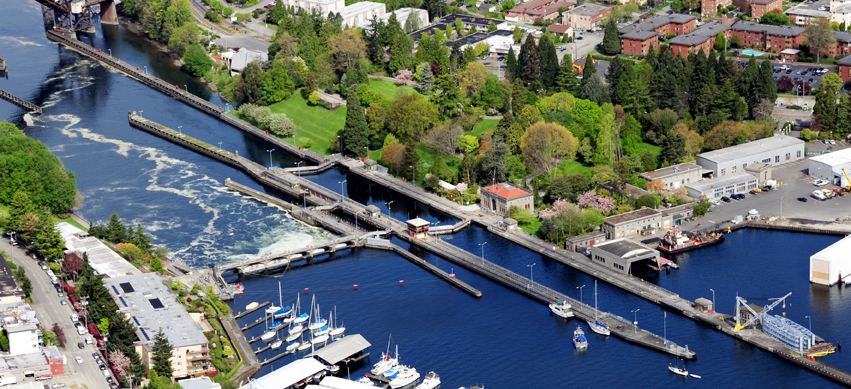
This is the Hiram Chittenden Locks that can now control lake
water level. Photo from US Army Corps of Engineers.
Once again, I did some extra research on this topic and my work couldn't have
been done without the help of Friends of Yesler Swamp and the US Army
Corps of Engineers.
Station #5 - Invertebrates
At the end of the trail
you come to the lake and many low hanging trees that really give Yesler swamp
that swamp kind of feel. Occasionally there will be some ducks back this far,
but one of the coolest things to do at this spot is to look for invertebrates!
There are logs on land and some in the water pretty close to the shore. Every
time I have looked under these logs I have found quite a few invertebrates. The
ones under logs in the stream are benthic invertebrates, benthic meaning lake
bottom in this case. The majority of the invertebrates found tend to still be
in their larval stage. Some examples are mayflies, caddisflies, stoneflies, and
dragonflies. These species belong to the orders ephemeroptera, trichoptera,
plectoptera, and odonata respectively. The biggest you will find them is
usually about the length of the diameter of a coin. Mayflies can be identified
by their 3 tails whereas stoneflies have 2. Caddisflies make shells out of
things around them and they typically just cling to the piece of wood or rock
you pick up.
Some other insects you can see outside of the water
include fire ants, which have bit my ankles and made them quite itchy, and you
can find plenty of bees. Both of these species belong to the hymenoptera
family. Some rarer things to find (at least in my experience) are butterflies
(lepidoptera) and beetles (coleoptera). I’ve briefly seen one medium sized
orange and black butterfly, and to my amazement have yet to see a beetle, so
keep your eyes open!


Soil centipede
Station #6 - Ecological disturbance
Here is an example of
an ecological disturbance. Around early May there was a windstorm that knocked
this tree over. At first glance you would think that this is a bad thing, but
some ecological disturbances are actually quite beneficial to the maturity and
growth of the swamp. The wood of the tree will slowly rot and decompose over
the following years, which will create another kind of niche in the swamp that
many invertebrates and birds may take advantage of. Decomposers will eat what
they can of the downed tree, and the soil around the tree will be fresh and
nutritious for other plants and animals in the surrounding area. The loss of
the standing tree may also open up some room for sunlight to break through the
canopy, so there is more room for other plants to grow in what use to be shaded
areas. Without occasional disturbances like this, there would not be much
diversity of plants in the swamp because it would just be full of tall
cottonwoods until they all died around the same age. The diversity of the plants
caused by disturbance in the swamp is important because that is what creates
habitat niches for specific animals in the form of tall healthy trees, snags,
and woody debris around the swamp flow, like we have in this case.


Here is the downed tree that was partially blocking the trail.
Station #7 - Animal behavior
As you approach the
water, I recommend being as quite as possible. Not only does this enhance our
senses a little, but it can also help you to see more animals up closer. There
are often frogs, turtles, and a few birds along the shoreline and once they hear
you, they will think you’re a predator and they’ll dive into the water or fly
away. The turtles are typically basking in the sun on a log floating on the
lake so that they can plop right in just in case an eagle or hawk comes after
them – but they’ll also treat humans the same if we get much closer than about
20 feet from my experience. When herons suspect danger they fly away and make loud
squawks which probably lets other animals know that there is something
dangerous where they were. Some animals are more subtle in letting other
animals know about danger. Chickadees have a call that sounds like “chick-a-dee-dee-dee”
and the amount of ‘dee’s vary depending on the level of danger; the more dee’s –
the more dangerous. It is fun to listen for this and try to figure out what the
danger is that they are worried about. More often than not, I think that when I
hear a chickadee call with many dee’s it’s because I am the danger rather than
a true predator.

Black capped chickadee. Photo credit to Kevin Bolton and the Cornell Lab or Ornithology.
Station #8 - Ecological interaction
An easy part of the
swamp to overlook is the interactions taking place among smaller organisms. It
takes some time to get an eye for it because we are surrounded by big trees and
singing birds that easily capture our attention. However, this specific part of
the swamp is neat because there are often fire ants at work. Twice I have
observed them and the last time I saw them they had a banana slug that I assume
had been killed by the ants. This is a great example of some of the
predator-prey interaction going on within the swamp. It is imperative to keep
an eye on these fire ants because they are good at swarming together and
attacking. Recently I was in this spot and suddenly I felt some sharp stinging
pain on my ankles and I looked down to see 5 or 6 ants on me. I ended up with 4
or 5 bites that all swelled up and felt similar to mosquito bites after the
initial stinging sensation left me. If they can do that to me, then the banana
slug probably didn’t stand a chance! This made me wonder if there may be some
kind of ‘arms race’ between fire ants and their prey. An example of an arms
race would be if the banana slug evolved to be resistant to the fire ants’
bite, followed by the fire ants evolving to alter their toxins or lethalness of
their bite, and so on. This is just one of the many interesting and
thought-provoking questions that can be raised from this seemingly small scale
ecological interaction.


Fire ants and an unfortunate banana slug.
Station #9 - Birds
This station is one of
my favorites! As you approach this station, it is most fun to be as quiet as
possible. Sometimes there are great blue herons just on the other side of the
cattails that you can get a real good look at if they don’t hear you too early.
When they fly away they make the most prehistoric dinosaur-like sounds that you
wouldn’t expect to hear right here within the city. Once you (accidentally) scare
any herons away, there are many other interesting birds to be seen as well.
There are almost always a couple pairs of mallard ducks swimming about. The
males have the bright green heads and the females are mostly brown. To eat,
they have bills that act as strainers to filter out everything they don’t want.
There are also gadwalls. The female gadwall looks very similar to the mallard
female, but the male gadwall is a grayish color and of similar size as the
mallard. If you bring binoculars you can look out toward the opening of this
little inlet and see some massive groups of coots that appear to just be
swimming around as a pack. Occasionally
if you’re really lucky, you can see a bald eagle soaring above hoping to spot
his next meal. One of the most fun things about birds is that if you observe
one of them long enough, you can see that they’re often trying to do something.
Birds don’t just fly around all day. If you sit and watch you can see them
eating or foraging, building a nest, singing for a mate, calling to warn others
of dangers, and much more.

A great blue heron! Photo credit to Helen Pine and the Cornell lab or Ornithology.
Station #10 - Beavers
One of the most unique
and amazing parts of Yesler Swamp are the beavers that can be seen! At the end
of the right-turn trail there is a great view of the lake and across the small
inlet you can see a beaver lodge. There aren’t always beavers swimming about,
but I have found that the best time to go and see them is at dusk. When I’ve
seen them at dusk they are normally just swimming with their heads poked up out
of the water. Occasionally they will dive and they curl their whole back as
they go under, which really shows how big some of them are! During the day I
have seen them once and it was quite fascinating. The usual calm and serene
inlet would occasionally be chaotic with water thrashing. I believe these were
beavers, but I wasn’t sure what they were doing because I believe their diet is
strictly vegetarian, so I don’t see a reason for the attack looking behavior.
Either way, the things you can see when you sit near the lake and stay patient
are very interesting. Another thing I have seen the beavers do is slap their
tail. I’ve only seen them do this when I have rented canoes and gotten in
between them and their lodge. The sound and splash they make is very impressive
and definitely worth seeing for yourself!

<https://en.wikipedia.org/wiki/North_American_beaver>.
Pine, Helen. "Great Blue Heron." All About Birds. Cornell Lab of Ornithology. Web. 9 Jun 2013.
<http://www.allaboutbirds.org/guide/Great_Blue_Heron/id>.
Here is an American Beaver! Note their webbed feet, hands they can grip things with, and large tail. Photo credit to wikipedia.
Thank you for reading. I hope this inspires some of you to go visit Yesler Swamp, or at least encourages you to get outside and appreciate the beauty this world has!
Sources:
Arnold, Carol. "History." Friends of Yesler
Swamp. N.p., 21 Mar 2013. Web. 9 Jun. 2013.
<http://yeslerswamp.org/history/>.
Bolton,
Kevin. "Black-capped Chickadee." All About Birds. Cornell Lab
of Ornithology. Web. 9 Jun 2013. <http://www.allaboutbirds.org/guide/Black-capped_Chickadee/id>.
"Hiram M. Chittenden Locks." . US Army Corps of
Engineers. Web. 9 Jun 2013.
<http://www.nws.usace.army.mil/Missions/CivilWorks/LocksandDams
/ChittendenLocks.aspx>
"North
American Beaver." Wikipedia. N.p., 27 May 2013. Web. 9 Jun 2013. <https://en.wikipedia.org/wiki/North_American_beaver>.
Pine, Helen. "Great Blue Heron." All About Birds. Cornell Lab of Ornithology. Web. 9 Jun 2013.
<http://www.allaboutbirds.org/guide/Great_Blue_Heron/id>.

No comments:
Post a Comment